Star Citizen: The $1 Billion Dream That Refuses to Die
Authored by PinkLloyd 10 min read Updated
- Star Citizen
- space games
- MMO
- Cloud Imperium Games
- Squadron 42
- Chris Roberts
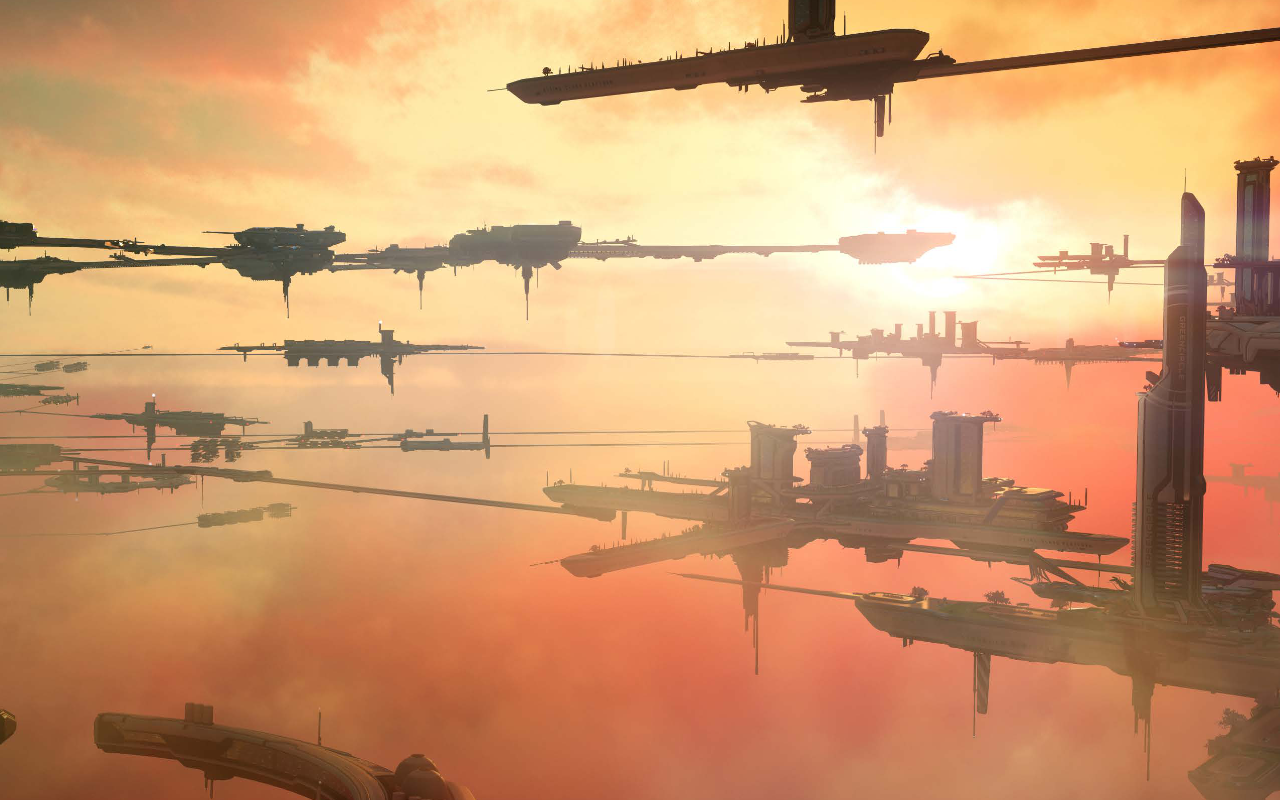
Orison — the floating cloud city of Crusader, Stanton system. Real in-game screenshot courtesy of Cloud Imperium Games.
Star Citizen: The $1 Billion Dream That Refuses to Die
By the numbers, Star Citizen shouldn't exist. A crowdfunded space game announced in 2012 with a 2014 release target has now raised nearly $1 billion, logged 64 million hours of play in a single year, and still doesn't have a release date for its full MMO. Yet over 1.5 million backers continue to fund it, fight for it, and genuinely love it. To understand why, you have to understand what Star Citizen is actually trying to do — and why nothing else comes close.
The Vision: A Universe You Can Touch
Most space games ask you to imagine the universe. Star Citizen asks you to inhabit it.
In Star Citizen, you don't click a button to "board your ship." You walk out of your apartment in a city rendered at street level, take a tram to a landing pad, ride an elevator down, walk through an airlock, and physically step onto your ship's deck. You sit in the pilot's seat, start the engines, and lift off — transitioning from a city on a moon's surface, through atmosphere, and into space — all without a single loading screen. When you arrive at your destination, you land, walk out, and continue your life in the persistent universe.
This is what players call "the dream" — and it's why no amount of delay has killed the project. Chris Roberts, the legendary designer behind Wing Commander and Freelancer, returned to game development in 2010 with a singular vision: build a living, breathing universe where first-person simulation extends to every layer of gameplay. Thirteen years later, the vision remains unmatched. And increasingly, it works.
Want to experience the dream firsthand? Join Star Citizen and start your journey in the 'verse.
What Sets It Apart From Every Other Space Game
The space game genre has excellent entries. Elite Dangerous offers a 1:1 scale Milky Way with billions of star systems and deep ship mechanics. No Man's Sky delivers colorful procedural exploration and survival. EVE Online hosts economy-driven political intrigue and thousand-ship fleet battles that have made headlines outside gaming.
None of them are doing what Star Citizen is doing.
Elite Dangerous built breadth — the Milky Way is vast but thin. Planets can feel empty, interactions are tightly constrained, and the game maintains a boundary between cockpit, space station, and ground that Star Citizen deliberately erases.
No Man's Sky built accessibility — it's welcoming, vibrant, and excellent at exploration and base-building. But it's fundamentally a survival and exploration experience, not a living civilization simulator.
EVE Online built depth of player politics — its emergent economy and warfare are legendary. But it operates from a top-down tactical view, and its simulation ends at spreadsheets and fleet commands.
Star Citizen's differentiator isn't scale of universe (it's targeting ~100 hand-crafted star systems, not trillions of procedural ones) or accessibility or political depth. It's fidelity of simulation across every layer of gameplay:
- You don't click "attack ship" — you crew a turret, lead your shots, and watch hull breach in real time
- You don't see a prompt "repair engines" — you walk to the engine room, seal the hull breach with a patch tool, reroute power, and fight fires with a fire suppressor
- You don't select "board enemy ship" — you fly alongside it, EVA across in zero gravity, cut through an airlock, and fight room-to-room in FPS combat
- You don't click "trade commodities" — you physically load cargo containers with a tractor beam, haul them aboard, and fly the route yourself
This isn't just aesthetics. It means every role has a human player behind it. A capital ship isn't a menu — it's a crew of ten players, each doing a specific job, communicating in real time, winning or losing together.
The Technology That Had to Be Invented
To build this vision, Cloud Imperium Games had to create technology that didn't exist.
Object Container Streaming broke the fundamental constraint of open-world games: that you can only simulate what fits in memory. Star Citizen divides its universe into discrete spatial containers that stream in and out as players move through space — with the server side doing the same. When this shipped in 2018, players reported 100% frame rate improvements overnight. Every other loadscreen-free open world game has its own version of this problem. CIG solved it for a universe-scale game.
Nested Physics Grids made the crew simulation possible. A ship has its own physics grid — players inside experience the ship's local gravity and can walk around even while the ship maneuvers at speed. These grids can be nested: a fighter docked inside a carrier exists on the carrier's grid, which exists on the planetary system's grid. The math for this required bespoke physics engine work.
Server Meshing, deployed live in December 2024 with Alpha 4.0, is perhaps the most significant. Traditional MMO servers own a fixed region. Star Citizen's universe is too complex for any single server. Server meshing allows multiple servers to collectively simulate one shared, seamless universe — players crossing server boundaries experience no transition. By early 2025, this reduced disconnections by over 57% and enabled stable play at hundreds of concurrent players per shard, with stress tests hitting 2,000.
Persistent Entity Streaming backs all of it with a universe-scale database that stores the state of every object — a cargo crate left on a moon, a ship parked in a hangar, a constructed base — so the universe persists between sessions and server restarts. No other MMO attempts this level of world-state persistence.
The Star Systems: From Corporate Space to the Lawless Frontier
As of 2026, three star systems are live in the Alpha:
Stanton is the original system — four planets and their moons, each with different political affiliations, economies, and cultures. From the corporate megacity of Lorville on Hurston to the pirate haven of GrimHEX hidden in an asteroid belt, Stanton is the beating heart of the current game. It's where you learn the universe, run missions, trade, explore, and die.
Pyro, added in December 2024, is the lawless frontier. Five planets orbit an unstable binary star. No law enforcement. Gang-controlled outposts. Valuable but dangerous resources. Pyro changed the tenor of the game — it's where players who want the edge go, and where consequences are real.
Nyx, added November 2025, brings alien wetlands, new environmental hazards, and threats unlike anything in the inner systems. It's the game's clearest signal that the universe has texture and variety — not just reskins of existing content.
Why the Community Loves It (Despite Everything)
Star Citizen backers have been waiting over a decade. Many have spent thousands of dollars — a small contingent, tens of thousands. And yet the community is not merely patient; it is passionate. Bar Citizens meetups are held worldwide. Organizations (player guilds) are elaborately structured. The community has developed its own culture, terminology, and internal mythology over thirteen years of shared investment.
Part of this is sunk cost, candidly — it's hard to abandon something you've invested in. But that's not all of it, or even most of it.
The vision is genuinely unique. Many backers say explicitly: there is no other game trying to do this. The major publishers will never greenlight it — the scope is too large, the timeline too uncertain, the payoff too speculative. The only way it gets built is if a community funds it directly. That logic remains true today, and it binds backers to the project in a way that goes beyond typical gaming loyalty.
The game actually delivers moments no other game can. Coordinating a multi-crew ship for the first time — pilot, co-pilot, gunner, engineer — through a harrowing combat engagement, all communicating on voice, all playing a role, with the ship physically responding around you — is an experience that no other game offers. When Star Citizen works, it is genuinely unlike anything else.
The 2025 "Year of Playability" delivered. Server meshing made the game meaningfully stable. New star systems arrived. Engineering gameplay gave crews new roles. 64 million hours were logged. For many long-time backers, 2025 was the first year where the alpha felt like a game rather than a tech demo.
Squadron 42: The Door to the Mainstream
Star Citizen's single-player companion, Squadron 42, is the project's commercial inflection point.
Featuring a voice cast that includes Mark Hamill, Gary Oldman, Gillian Anderson, Henry Cavill, and Mark Strong, Squadron 42 is a story-driven campaign following a new UEEN naval recruit through a war against the alien Vanduul. In December 2025, Chris Roberts confirmed the campaign is "fully playable from beginning to end" — over 40 hours — with development now focused on polish and optimization ahead of a 2026 release.
Squadron 42 matters beyond its own merits. It is the game's entry point for players who won't buy into an open-ended alpha MMO. It is the narrative foundation for the broader universe. And its revenue is expected to fund continued Star Citizen development. A successful Squadron 42 launch would be the largest single event in the project's history — the moment Star Citizen stops being a crowdfunded phenomenon and becomes a mainstream game.
The Controversy Is Real, and So Are the Criticisms
Honest coverage of Star Citizen cannot ignore the legitimate criticisms.
The project has been in development for over 13 years against an original 2014 target. Scope expanded continuously — what was pitched to Kickstarter backers in 2012 is a fraction of what CIG is now building. The leadership made promises that have repeatedly slipped.
The funding model is ethically complex. Selling ship packages priced at $400, $1,000, or $48,000 for a game still in alpha raises real questions. In 2025, CIG released ship components exclusively through the paid store before making them available in-game — a direct pay-for-advantage mechanism that the community pushed back hard on. CIG reversed course, but the incident revealed the tension inherent in a forever-funding development model.
Refund policies have tightened over the years. Management accountability for nearly $1 billion in funds remains limited. Layoffs in late 2024, despite record fundraising, were jarring.
These criticisms don't make Star Citizen a scam — an enormous amount of work has been done and a functional product exists. But they make it a complicated investment, and anyone considering backing should understand they are funding an ongoing development process, not purchasing a finished product.
What Comes Next
The path to Star Citizen 1.0 is clearer in 2026 than it has ever been:
- Squadron 42 targets a 2026 release — the most concrete milestone in the project's history
- Alpha 4.7 (March 2026 target) continues server meshing improvements and introduces crafting foundations
- Alpha 4.8 brings a full universe wipe (to address exploits and item duplication) and new content
- 1.0 scope includes 5 star systems, player-owned space stations, full base building, a complete player-driven crafting and manufacturing economy, and the finished server meshing infrastructure — targeted for 2027–2028
For 1.5 million backers who have waited over a decade, that timeline means several more years of alpha. But the 2024–2026 period has delivered the most meaningful progress in the project's history: a second and third star system, live server meshing, new gameplay systems, and Squadron 42 approaching completion.
The Bottom Line
Star Citizen is the most ambitious video game ever attempted. It has also been the most delayed, the most expensive, and the most controversial. Both of these things are true, and they are inseparable.
What keeps it alive — beyond sunk cost, beyond community inertia — is that the vision remains real and remains unmatched. The seamless transition from city to ship to space to alien world, the multi-crew capital ship experience, the universe that persists and remembers — nobody else is building this. The question has never really been whether Star Citizen is worth playing. The question has always been whether Cloud Imperium Games can finish it.
In 2026, for the first time in thirteen years, the answer feels closer to yes.
Ready to take the controls? Join Star Citizen and see why over 1.5 million backers can't put it down.
Star Citizen is currently available for backers in Alpha 4.x. Squadron 42 targets a standalone release in 2026. Star Citizen 1.0 is projected for 2027–2028. All funding milestones and alpha content reflect the state of the game as of May 2026.